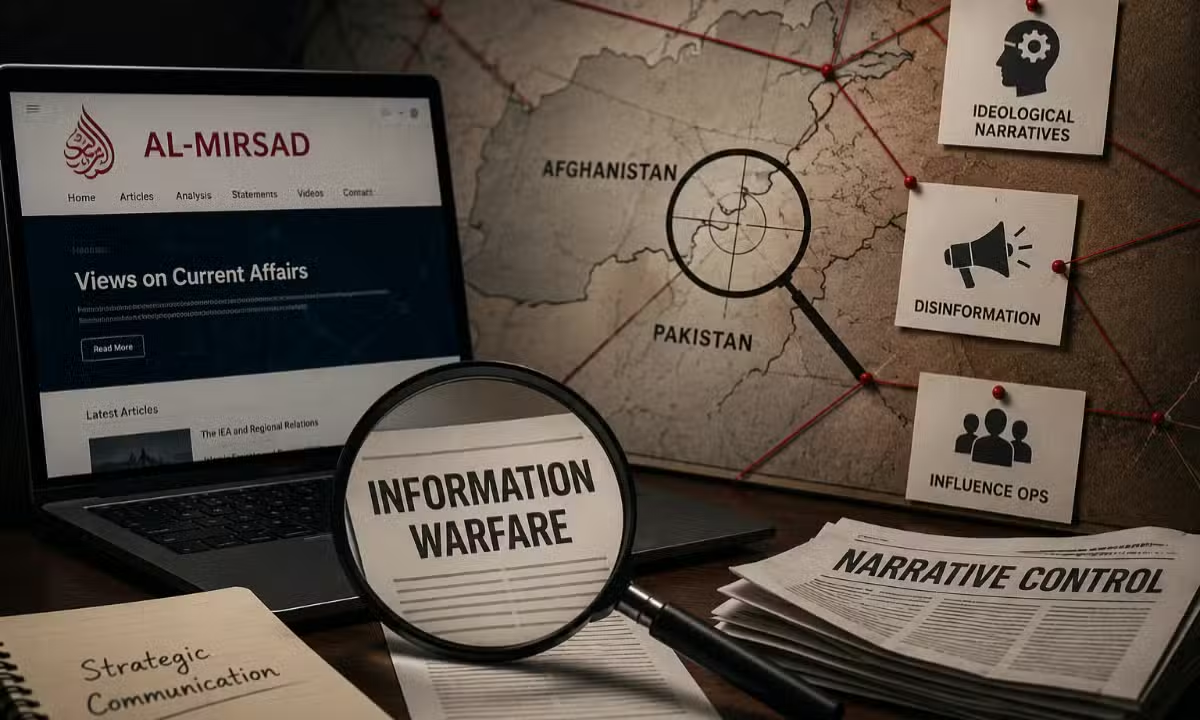
A recent analytical report published by The Durand Dispatch – Strategic Messaging has examined the role of Al-Mirsad, describing it as part of a coordinated strategic communication apparatus reportedly linked to the Taliban authorities in Afghanistan.
The 17-page study, authored by researcher Joey Moran, analyzed 137 English-language articles published between January 2025 and March 2026. It argues that Al-Mirsad does not function as an independent media outlet but instead operates as a structured platform aimed at shaping international perceptions and advancing specific political narratives.
According to the report, the platform focuses on three primary objectives, including the delegitimization of the Islamic State Khorasan Province (ISKP), the reframing of Pakistan as a central regional adversary, and the promotion of the Islamic Emirate of Afghanistan as a legitimate governing authority in the eyes of the international community.
The study claims that Al-Mirsad consistently portrays ISKP as an externally influenced militant organization while using ideological framing to question its legitimacy. It also suggests that Pakistan is frequently depicted as a source of regional instability, with narratives emphasizing cross-border tensions and security concerns.
Researchers further argue that the platform selectively highlights instances of international engagement involving Afghan authorities while downplaying internal governance challenges or issues that could weaken its legitimacy narrative. This selective presentation, the report notes, is designed to reinforce a specific perception among international policymakers and analysts.
The analysis also highlights the use of modern English-language communication strategies, suggesting that Al-Mirsad combines ideological messaging with professional-style reporting formats to reach global audiences. This approach, according to the study, reflects a broader shift in how regional actors engage in information influence campaigns.
The report concludes that future regional conflicts will increasingly involve competition over narratives of legitimacy and sovereignty, with information spaces becoming a key strategic battleground. It recommends that affected states develop stronger coordinated communication strategies and counter-disinformation frameworks to address evolving information challenges.
The findings have contributed to ongoing discussions about the role of media platforms in regional geopolitics and the growing importance of narrative control in shaping international perceptions of conflict and governance.